Piriformis syndrome · St. Louis
A diagnosis of exclusion that gets handed out as a first guess.
Piriformis syndrome is irritation of the sciatic nerve by the piriformis muscle deep in the buttock. It causes buttock pain that can spread down the leg. It is real, but the label is used far more often than the condition occurs. It belongs after the more common causes are ruled out, not before.
What causes piriformis syndrome?
The piriformis runs from the sacrum (the base of the spine) to the greater trochanter (the bony point of the hip). The sciatic nerve passes beneath it or, in a minority of people, through it. If the muscle is in spasm or hypertrophied (enlarged), it can in theory irritate the nerve. That would cause buttock pain that spreads down the leg.
That is a real mechanism. The problem is that, at a glance, it looks the same as lumbar radiculopathy, sacroiliac referral and facet referral. All of those are considerably more common. Reaching for piriformis first is guessing the rare answer.
What else feels like piriformis syndrome?
- Lumbar radiculopathy (a pinched nerve root in the lower back), which causes the same leg pain from a root. Radiculopathy.
- Sacroiliac joint referral, whose pain sits in exactly the same part of the buttock. The SI joint.
- Facet referral, which reaches the buttock and stops above the knee. Facet syndrome.
- Gluteal tendinopathy, tender over the bony point of the hip and painful lying on that side. Hip or back.
Work through those four, and few people are left with genuine piriformis syndrome. It is not zero, which is why the page exists.
What are the signs of piriformis syndrome?
- Deep buttock pain, worse with long sitting, especially on a hard surface or a wallet.
- Pain when you press deep on the muscle itself, not on the sacroiliac line or the trochanter.
- Pain brought back by resisted external rotation (turning the leg out against force). The FAIR position does it too — flexion, adduction, internal rotation.
- No true neurological deficit. No dermatomal numbness (in a nerve root’s skin map), no myotomal weakness (in a nerve root’s muscles), normal reflexes. A deficit means a root, not a muscle.
How do you get rid of piriformis syndrome?
- Exclude the spine and the sacroiliac joint properly. This is most of the work.
- Targeted soft-tissue and movement work — stretch the muscles that turn the hip out. Also build the hip abductors and extensors, since a weak gluteus medius is often what has the piriformis overworking.
- Address how long and how you sit, including the wallet and the driving position.
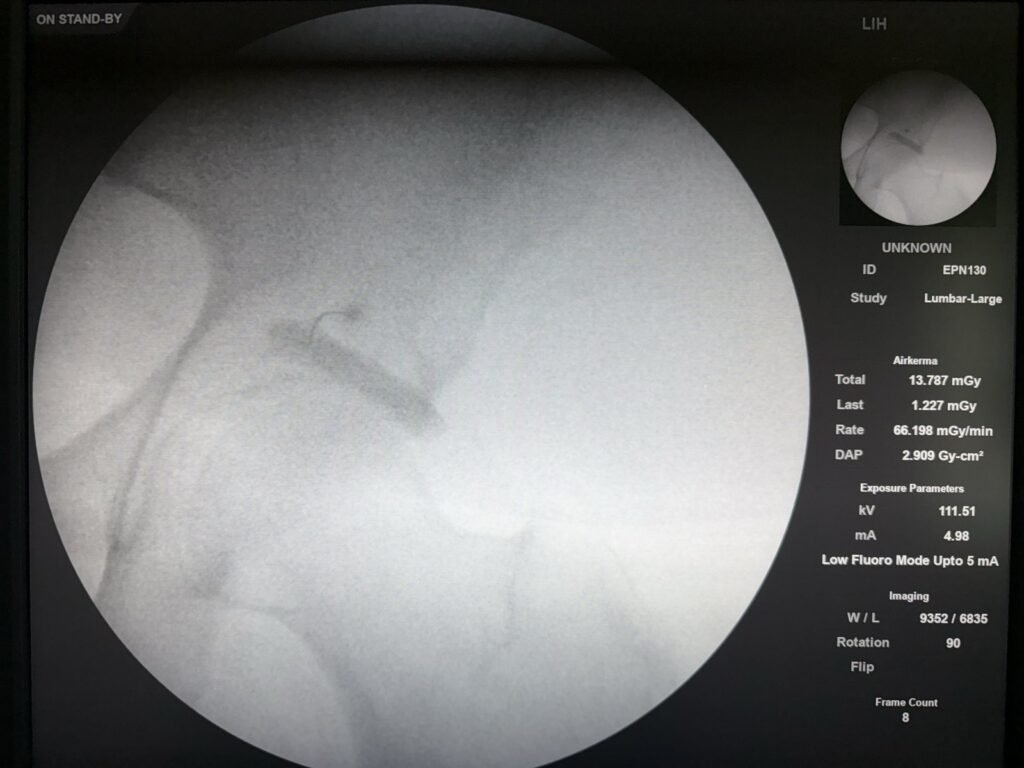
- Image-guided injection into the muscle when we truly suspect the diagnosis and conservative work has failed. This is also diagnostic, because relief confirms the source.
Frequently asked questions
Is piriformis syndrome real?
Yes, and it is over-diagnosed. Both statements are true. The issue is not whether the condition exists. It is the habit of naming it before ruling out more common causes.
Will stretching fix it?
Stretching alone often gives short-term relief that does not hold. That is because the muscle is usually overworking to make up for weak hip abductors. Strengthening those changes the demand.
How is it different from sciatica?
“Sciatica” describes leg pain in the sciatic distribution from any cause. Piriformis syndrome is one uncommon cause of it. Read the full list of what causes sciatica.
What triggers piriformis syndrome?
Sitting is the usual trigger, especially long stretches on a hard surface or on a wallet in your back pocket. The driving position counts too. Underneath that, a weak gluteus medius often leaves the piriformis overworking to steady the hip. When the muscle is in spasm or enlarged, it can irritate the sciatic nerve that runs beneath it or, in some people, through it.
How is piriformis syndrome diagnosed?
Mostly by ruling out the more common causes first: a pinched lumbar nerve root, the sacroiliac joint, the facet joints and gluteal tendinopathy. What points to piriformis is deep tenderness over the muscle itself. Another sign is pain brought on by resisted outward rotation of the hip or the FAIR position. And there is no true nerve deficit. Numbness, weakness or changed reflexes mean a nerve root, not a muscle.
Does a piriformis injection help?
It can, in the right patient. An image-guided injection into the muscle is used when the diagnosis is truly suspected and other steps have not been enough. Those steps are strengthening, movement work and changes to how you sit. It also answers the diagnostic question. If the injection relieves the pain, the piriformis was the source. If it does not, the search continues elsewhere.
Can a nerve get pinched in the buttock instead of the spine?
It can. The sciatic nerve can be irritated in the deep buttock as well as at the spine; the umbrella term is deep gluteal syndrome, and the piriformis is only one of the structures that can do it, alongside the hamstring origin at the sit bone and scarring after a fall onto the buttock. It produces deep buttock pain with sitting and symptoms down the leg, usually without the strip of numbness and lost reflex a lumbar root produces. Treatment follows the culprit: how you sit, rebuilding the hip abductors, and an image-guided injection when the exam points there. Sit-bone pain that keeps getting called sciatica is another look-alike.
Related reading
- Sciatica, and what impersonates it
- Sacroiliac joint pain
- Hip or back
- Lumbar radiculopathy
- Hamstring tendonitis
If you were told piriformis without an examination, it was a guess
We will work through the four commoner causes first. If they are all negative, the label starts to mean something.
12174 Natural Bridge Rd, Suite 301
St. Louis, MO 63044
At DePaul Hospital on Natural Bridge Road, inside the I-270 and I-70 interchange, on the west side of the airport.
Sources
- Hopayian K et al. The clinical features of the piriformis syndrome: a systematic review. European spine journal : official publication of the European Spine Society, the European Spinal Deformity Society, and the European Section of the Cervical Spine Research Society, 2010. PubMed 20596735
- Sharma S et al. Looking beyond Piriformis Syndrome: Is It Really the Piriformis?. Hip & pelvis, 2023. PubMed 36937215
- Probst D et al. Piriformis Syndrome: A Narrative Review of the Anatomy, Diagnosis, and Treatment. PM & R : the journal of injury, function, and rehabilitation, 2019. PubMed 31102324
- Fishman LM et al. Piriformis syndrome – a diagnosis comes into its own. Muscle & nerve, 2019. PubMed 30623985