Epidural steroid injection · St. Louis
It does not shrink the disc. It buys you the window in which the disc shrinks itself.
An epidural steroid injection places anti-inflammatory medicine around an irritated nerve root. Think of it as a way through a stretch of pain that would otherwise be unmanageable, and it is a good procedure. Think of it as a repair, and it disappoints. Most letdowns come from that mismatch, not from the injection.
What does an epidural steroid injection treat?
Radicular pain (pain that runs along a nerve root) is driven by inflammation around the root as much as by pressure on it. Disc material that has pushed out is chemically irritating on its own. The inflammation it sets off is what makes the root sensitive. That inflammation is what the steroid treats.
That explains both the strength and the limit. Calm the inflammation, and the pain often drops substantially. You can move, sleep and let the natural course play out — and a large share of disc herniations do resorb (shrink back) on their own, given that time. The steroid did not shrink the herniation. It made the wait survivable.
What are the types of epidural steroid injection?
TRANSFORAMINAL
The needle is placed at the foramen (the opening) where the root causing symptoms exits, so the medicine goes straight to the target. It uses less volume and is more specific. Relief at a single level points to that level, so it gives diagnostic information as well as treatment. This is the preferred route when a single root is the problem, and it is what we use in most radicular cases.
INTERLAMINAR
The needle enters the epidural space between the laminae (the bony arches at the back of the spine), and the medicine spreads more widely. It makes sense when symptoms are on both sides or at more than one level. It also fits when the anatomy makes a transforaminal approach unwise. It is less specific. So it tells us less about which level is to blame.
CAUDAL
The needle enters through the sacral hiatus (an opening at the base of the spine), well below the target. A larger volume spreads upward. It is useful in a spine that has had surgery, where scarring makes other routes hard. It is the least targeted of the three.
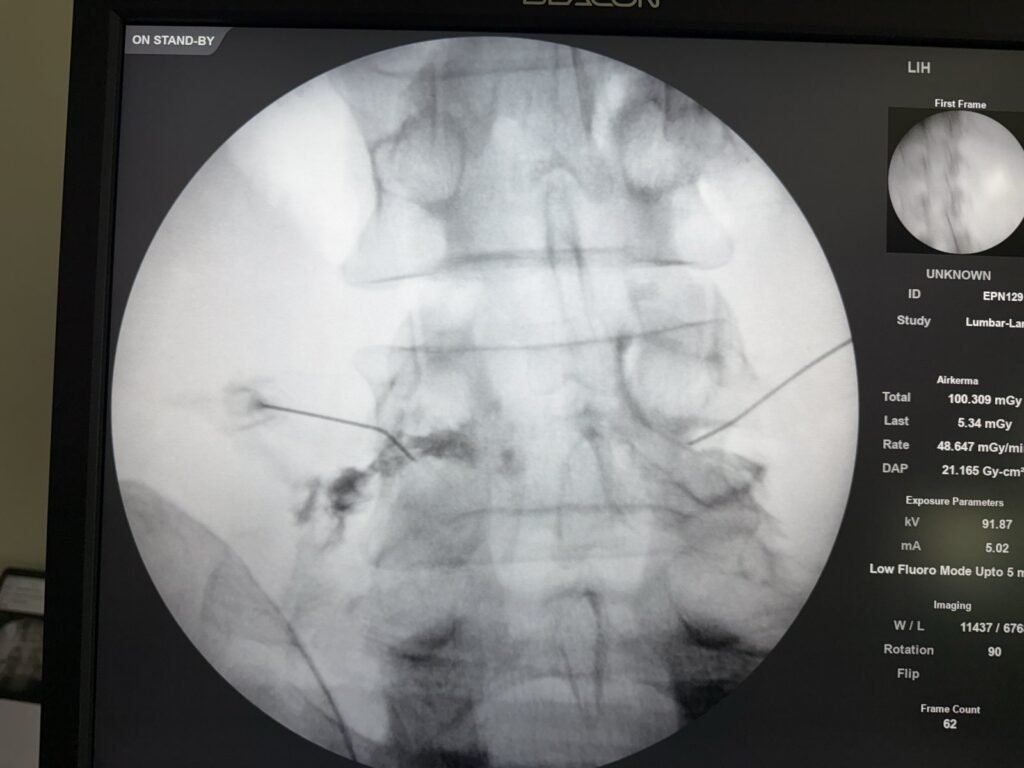
All of them are done under fluoroscopic guidance (live X-ray). Contrast dye confirms the spread before the medicine is given. A blind epidural in the lumbar spine misses its target often enough that image guidance is not an extra. It is the standard.
When is an epidural steroid injection worth doing?
- Radicular pain with a matching exam and, where imaged, a matching level. Radiculopathy.
- Severe enough to prevent sleep, work or movement — because the injection is weighed against the cost of leaving the pain untreated.
- As a test to confirm the level when imaging shows more than one candidate.
- In stenosis (a narrow spinal canal), to reduce the inflammation around squeezed roots. That opens a window for conditioning work. It does not widen the canal. Stenosis.
When should you not get an epidural steroid injection?
Axial low back pain (pain only in the back) with no radicular part is the big one. Your pain may sit across the back and not travel along a nerve path. If so, an epidural is aimed at a structure that is not causing your symptoms. The likely candidates are the facet joints or the sacroiliac joint, which need entirely different tests. A large share of the epidurals that disappoint were given for this.
It is also not the answer to a progressive neurological deficit (nerve loss that keeps getting worse). Weakness that is worsening is a surgical conversation. Using an injection to buy time there costs function that does not come back.
What are the side effects of the steroid in an epidural?
Corticosteroid is a systemic drug given locally, and it does not stay entirely local. Most of our patients are metabolically unwell, so that is worth saying plainly, not glossing over. A steroid injection raises blood glucose for days, and in a diabetic patient that rise can be substantial. If you are diabetic, monitor closely for about a week. Tell us in advance so the dose and the plan account for it.
Repeated steroid exposure over time also affects bone density and the adrenal axis (the stress-hormone system). That is one reason this practice does not run standing courses of three. There is no magic in a series. How many you get is a medical choice. It is measured against what the last shot did. And where a lasting non-steroid answer exists — as it does for confirmed facet pain, in radiofrequency neurotomy — we go there instead.
The wider point is the one this practice keeps coming back to. Say the whole body is making inflammation. Injecting an anti-inflammatory in one spot then asks a local treatment to hold back a whole-body process. Insulin resistance and metabolic inflammation raise the baseline the local response starts from. They impair the microcirculation (tiny blood vessels) the nerve root depends on. And they slow the resorption the window is supposed to allow. That is why bloodwork is part of this visit. It is not a separate program you get sold later.
What happens on the day
- Baseline pain and symptom map recorded, including where the leg pain stops.
- Face down, skin cleaned and anesthetized.
- Needle advanced under live fluoroscopy, then contrast. It shows on screen that the drug will land in the target space and not inside a blood vessel.
- Medication delivered, and the needle removed. The whole thing is short.
- Observation, then home. There is no sedation, so most people drive themselves home; if a leg is temporarily weak or numb, someone else drives until it passes. Keep a record over the next two weeks. The numbing effect in the first hours is a separate piece of information from the steroid effect that builds over days.
Frequently asked questions
How long does it take to work?
Local anesthetic gives relief within the hour, and then it wears off. That early window tells us the medicine reached the right place. The steroid effect typically builds over two to seven days and is judged at two weeks.
Related: sacroiliac joint injection.
How long does it last?
It varies widely — weeks to many months. When a herniation resorbs during the window, the relief can simply last, because the problem went away underneath it.
Related: lumbar medial branch block.
How many can I have?
There is no fixed number and no pre-booked course here. Each one is a decision made against what the last one achieved, weighed against the build-up of steroid effects.
The condition it treats is covered in lumbar radiculopathy.
Does it hurt?
The skin numbing stings. Most people feel pressure after that. Some feel a brief return of their leg pain as the needle nears the root. That is uncomfortable, and it tells us something.
Related: sacroiliac joint injection.
Will it interfere with surgery later?
Generally no. There is usually an advised gap between a shot and surgery at the same site. If surgery is being planned, tell us and we will coordinate the timing.
Related: lumbar radiculopathy.
What is the success rate of an epidural steroid injection?
It depends on matching the injection to the problem. Take radicular pain, meaning pain that travels along a nerve root, with a matching exam and a matching level on imaging. There, the pain often drops substantially. Back pain that stays across the back and does not travel is different. An epidural there is aimed at a structure that is not causing the pain. A large share of disappointing epidurals were given for exactly that.
What are the benefits of an epidural steroid injection?
It calms the inflammation around an irritated nerve root, which is a large part of what drives the pain. With less pain, you can move, sleep and work while the disc does its own repair. A large share of disc herniations resorb on their own, given that time. A transforaminal injection also shows which level is to blame, because relief at one level points to that level.
What should I do after an epidural steroid injection?
You are watched for a short time before going home. Keep a record of your pain over the next two weeks. Relief in the first hours comes from the local anesthetic. The steroid effect builds over two to seven days and is judged at two weeks. If you are diabetic, tell us before the injection. Then monitor your blood glucose closely for about a week afterward, because the steroid raises it.
Related reading
- Lumbar radiculopathy
- Is it actually the disc?
- Spinal stenosis
- Sciatica, and what impersonates it
- Before you agree to the operation
An injection should have a stated job and a stated endpoint
Before we do one we will tell you what it is for, what would count as it working, and what we do if it does not. If an epidural is the wrong tool for your pattern, you will hear that instead.
12174 Natural Bridge Rd, Suite 301
St. Louis, MO 63044
At DePaul Hospital on Natural Bridge Road, inside the I-270 and I-70 interchange, on the west side of the airport.
Sources
- Mahmoud AM et al. A systematic review and network meta-analysis comparing different epidural steroid injection approaches. Pain practice : the official journal of World Institute of Pain, 2024. PubMed 37700550
- Armon C et al. Epidural Steroids for Cervical and Lumbar Radicular Pain and Spinal Stenosis Systematic Review Summary: Report of the AAN Guidelines Subcommittee. Neurology, 2025. PubMed 39938000
- Lee JH et al. Comparison of clinical efficacy of transforaminal and caudal epidural steroid injection in lumbar and lumbosacral disc herniation: A systematic review and meta-analysis. The spine journal : official journal of the North American Spine Society, 2018. PubMed 30030083
- Lee JH et al. Comparison of Clinical Efficacy of Transforaminal and Interlaminar Epidural Steroid Injection in Radicular Pain due to Cervical Diseases: A Systematic Review and Meta-analysis. Pain physician, 2022. PubMed 36608007