Lumbar medial branch block · St. Louis
The only test that finds facet pain. There is no scan for it.
A lumbar medial branch block is a test, not a treatment, and understanding that distinction is most of what makes it work. We place a small amount of local anesthetic on two named nerves. If your pain goes while it is working, the joint those nerves serve is the source. If it does not, we have ruled out something real and we look elsewhere.
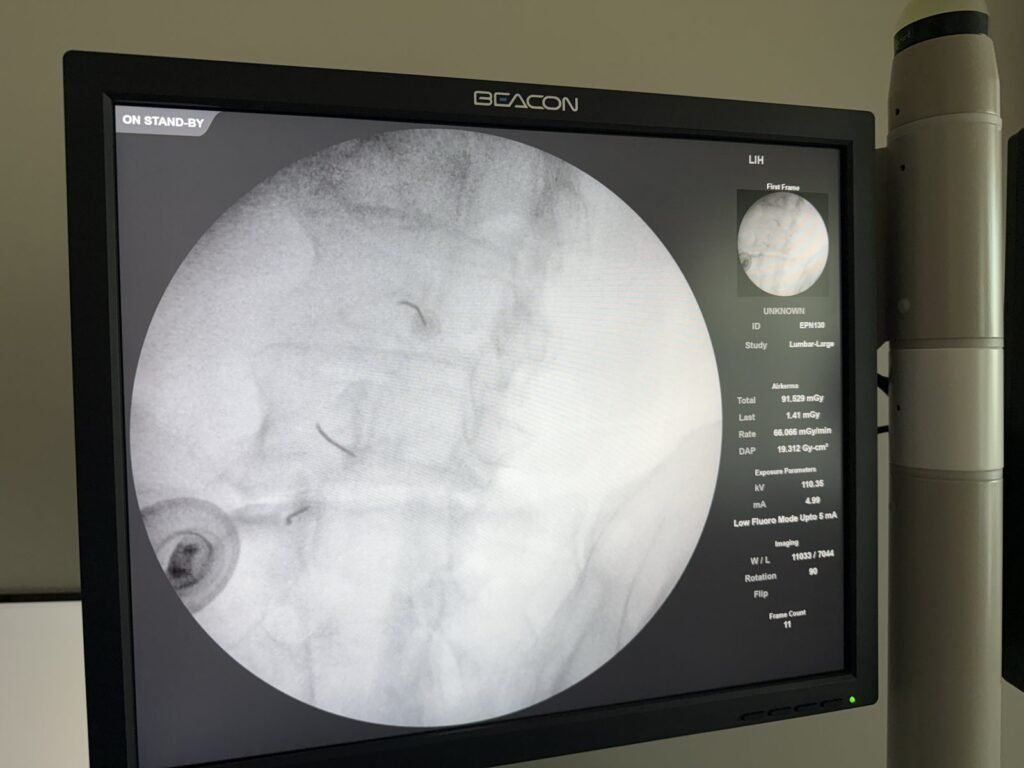
How does a lumbar medial branch block work?
Each lumbar facet joint (the small joints at the back of the spine) gets its nerve supply from two levels. These nerves are the medial branches of the dorsal rami. One comes from the level of the joint and one from the level above. They run in a predictable groove in the bone. That is why we can reach them reliably under fluoroscopic guidance (live X-ray). That is also why the target is a landmark, not a guess.
These nerves only carry feeling from the joint and the tissue right around it. So numbing them gives a clean experiment: the joint stops reporting and nothing else changes. That is the closest thing this field has to a controlled test of where pain is coming from.
What happens during a lumbar medial branch block?
- You rate your usual pain before we start. You also describe the movements that reliably bring it on. The whole test is measured against this baseline, so be precise rather than stoic.
- You lie face down. We clean the skin and numb it with a small shot of local anesthetic. Most people find this the least comfortable part.
- Under live fluoroscopy, a fine needle is placed on each target. That is usually two or three per side. We confirm the position on two views before anything is injected.
- A small volume of local anesthetic goes onto each nerve. Small is on purpose. A large volume spreads to structures that are not the target. That turns a specific test into a vague one.
- You get up and move. On purpose, into the positions that normally hurt. A test where you lie still afterward tells us almost nothing.
- You keep an hourly record for the rest of the day, on paper we give you. This is the result. Not an impression the following week. Hours, with numbers.
The whole appointment is short. No general anesthetic is used, and none is needed. You have to be able to report what you feel, which is the point.
What do medial branch block results mean?
A CLEAR POSITIVE
Strong relief, by convention around 80 percent or more. It lasts roughly as long as the anesthetic should, and the pain returns as it wears off. That pattern marks the facets at those levels as the pain source. It makes radiofrequency neurotomy the logical next step.
A PARTIAL RESPONSE
Real but partial relief usually means the facets are adding to the pain alongside something else. That is commonly the sacroiliac joint or a disc. This is useful information, not a failed test. It usually points to testing the second structure rather than treating the first.
A CLEAR NEGATIVE
No change. The facets at those levels are not causing your pain. Any plan built on the idea that they were has just been stopped. Patients find this outcome the most disappointing. It is also the one that most often saves them from a procedure that would not have worked.
Why are two medial branch blocks usually needed?
A single block has a meaningful false-positive rate. Placebo response is real, anesthetic spreads, and people want to feel better. So we do a confirmatory block on a separate day, ideally with a drug that lasts a different length of time. That substantially raises the odds that a positive result is real.
That second visit is inconvenient and we ask for it anyway, because the treatment it unlocks is worth being right about. Cutting a corner here produces a neurotomy that was never going to help. Then the patient gets labeled as having failed radiofrequency ablation.
Why there is no steroid in a diagnostic block. Steroid would make the relief last longer. That sounds better, but it destroys the test. The whole logic depends on the relief ending when the anesthetic ends. If you were given a “facet injection” with steroid and told it was diagnostic, those were two different procedures wearing the same name.
What are the side effects of a lumbar medial branch block?
This is a low-risk outpatient procedure, but it is not a no-risk one. Expect the needle sites to ache for a day or two. Now and then the anesthetic spreads further than intended. That can leave a numb or heavy leg for a few hours, which clears as the drug does. Bleeding, infection and nerve injury are uncommon. Steroid is not used, so its metabolic effects do not apply here. That matters more in this population than it usually gets credit for.
If you take an anticoagulant (blood thinner), tell us before the appointment, not on the day. Most are manageable with planning. Some need a pause that has to be arranged with whoever prescribed it.
What we need from you
Honest numbers. The most common way this test fails is not technical. It is a patient who wants the answer to be yes and reports relief generously. That patient ends up with a treatment aimed at the wrong structure. A negative block reported accurately is worth more to you than a positive one reported hopefully.
The second thing is movement. Get up and do the thing that hurts. A block checked at rest measures very little, because a facet joint under no load was not going to hurt anyway.
Frequently asked questions
Does it hurt?
The skin anesthetic stings briefly. After that most people describe pressure rather than pain. It is a short procedure and you walk out of it.
Lumbar facet syndrome goes through the condition this test looks for.
Can I drive afterward?
Yes, most patients drive themselves home. No sedation is used; you stay awake under local anesthetic. Normal activity, including work, resumes within two to four hours. If a leg feels weak or numb, have someone else drive until that wears off.
The next step after a positive block is covered in lumbar radiofrequency ablation.
What if it only helps for a few hours?
That is exactly what is supposed to happen. The relief ending as the anesthetic ends is what makes the result readable.
Related: epidural steroid injection.
Is this the same as a facet joint injection?
No. A facet joint injection places steroid inside the joint capsule and aims to treat. A medial branch block places anesthetic on the nerves outside the joint and aims to diagnose. They serve different purposes, and people commonly confuse them.
Related: sacroiliac joint injection.
What if both blocks are positive?
Then you have a confirmed diagnosis. That is more than most people with years of back pain have ever been given. You also have a clear next step in radiofrequency neurotomy.
Can you walk after a medial branch block?
Yes, and you are asked to. Right after the block you get up and do the movements that normally hurt, because a facet joint at rest was not going to hurt anyway. You then keep an hourly pain record for the rest of the day. Most patients drive themselves home, and normal activity, including work, resumes within two to four hours. If a leg feels weak or numb, have someone else drive until that wears off.
What is the next step if a medial branch block doesn’t work?
A clear negative means the facet joints at those levels are not causing your pain, so we look elsewhere. That result is useful, because it stops a treatment that would not have worked. A partial response usually means the facets are contributing along with something else, often the sacroiliac joint or a disc, and the next step is testing that second structure.
Is a medial branch block worth it?
Yes, because it answers a question no scan can: whether a facet joint is causing your pain. A positive result on two blocks gives you a confirmed diagnosis and a clear next step in radiofrequency neurotomy. A negative result saves you from a procedure aimed at the wrong joint. Either way you leave with an answer instead of a guess.
Related reading
- Lumbar facet syndrome
- Radiofrequency neurotomy
- What your MRI actually showed
- What happens at the first visit
- Pain after back surgery
A test that can come back negative is the only kind worth doing
If nobody has blocked your facets, nobody has tested them, and every plan built on that assumption is unverified. We will tell you which levels we suspect and why before we go near them.
12174 Natural Bridge Rd, Suite 301
St. Louis, MO 63044
At DePaul Hospital on Natural Bridge Road, inside the I-270 and I-70 interchange, on the west side of the airport.
Sources
- Wahezi SE et al. Lumbar Medial Branch Block Volume-Dependent Dispersion Patterns as a Predictor for Ablation Success: A Cadaveric Study. PM & R : the journal of injury, function, and rehabilitation, 2018. PubMed 29174073
- Roy C et al. Correlation of lumbar medial branch neurotomy results with diagnostic medial branch block cut off values: a letter to the editor. Pain medicine (Malden, Mass.), 2013. PubMed 23565823
- Manchikanti L et al. Comprehensive Evidence-Based Guidelines for Facet Joint Interventions in the Management of Chronic Spinal Pain: American Society of Interventional Pain Physicians (ASIPP) Guidelines Facet Joint Interventions 2020 Guidelines. Pain physician, 2020. PubMed 32503359
- Sherwood D et al. Lumbar medial branch block progression to radiofrequency neurotomy: A retrospective audit of clinical practice. Interventional pain medicine, 2022. PubMed 39238824