Sacroiliac joint injection · St. Louis
A joint this deep cannot be injected by feel. If it was not imaged, it was not necessarily treated.
A sacroiliac joint injection places local anesthetic inside the joint to test whether it is generating your pain. It places steroid in the same space to settle an inflamed joint. It has to be image-guided. The joint is deep, narrow and irregular, and blind injections into it miss the joint space a great deal of the time.
What is a sacroiliac joint injection used for?
It has two jobs. Keep them separate in your head. As a diagnostic procedure, local anesthetic placed inside the joint tells us whether the joint is generating your pain — the same logic as a medial branch block. As a therapeutic procedure, steroid placed in the same space can settle an inflamed joint for a meaningful period.
Both are often done in one appointment. That is efficient, but it slightly muddies the diagnostic reading. Sometimes the answer really matters — for instance, before considering fusion of the joint. Then the diagnostic block is worth doing on its own terms, with anesthetic only.
Why does an SI joint injection need image guidance?
The joint is a narrow, curved gap set at an angle. It is often only a few millimeters wide and partly hidden by ligament and bone. Studies of unguided injection into it show it hits the joint far less often than a diagnostic test requires. That is not a criticism of anyone’s hands; it is anatomy.
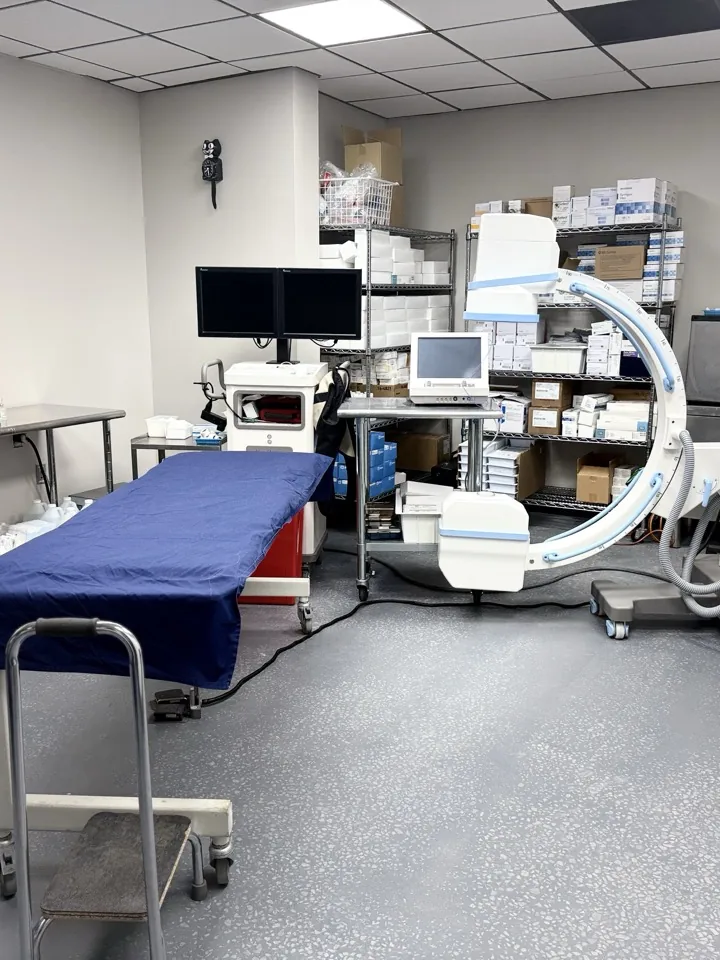
Under fluoroscopy (live X-ray), the needle enters the joint’s lower third. That is the part that is genuinely synovial (lined like a true joint). Contrast dye goes in ahead of anything else. The contrast pattern confirms the medication is inside the joint capsule rather than around it. Only then does anything else go in.
Maybe you have had a sacroiliac injection that did not help. The first question is whether it was image-guided, and whether contrast confirmed spread inside the joint. If not, the joint has not been ruled out, and it stays on the list. Sacroiliac joint pain.
How is SI joint pain confirmed before an injection?
- Provocation testing. We need three or more positives from the standard set of tests — distraction, thigh thrust, compression, sacral thrust, Gaenslen. Only then is the joint a serious candidate.
- The hip is examined at the same visit. A worn hip refers pain into the groin and buttock. It gets treated as a spine or sacroiliac problem for months at a time.
- The lumbar spine is examined properly, because facet pain and sacroiliac pain spread to overlapping areas, and both are common.
- A baseline is recorded, including the exact movements that bring on your pain — rolling over, stairs, standing on one leg.
What happens during and after an SI joint injection?
You lie face down. The skin is cleaned and numbed. The needle is advanced under live fluoroscopy into the lower joint, and contrast confirms the position. Medication follows. It is short, no general anesthetic is used, and most people drive themselves home; if a leg is temporarily weak or numb, someone else drives until it passes.
Afterward, follow the same steps that make any block readable. Get up, move into the positions that hurt, and keep an hourly record. Relief while the anesthetic works is the diagnostic result. Any longer-lasting benefit from steroid develops over days and is assessed at two weeks.
Expect soreness at the injection site for a day or two. If steroid was used and you are diabetic, expect a rise in blood glucose for several days, and monitor it. Tell us beforehand so it can be planned for rather than discovered.
What are the treatment options if the SI joint is the problem?
Once the sacroiliac joint is confirmed as the source, options open up that you would not have otherwise. It also rules out a lumbar operation that would have missed the target entirely. What follows depends on how durable the response is:
- Therapeutic injection, where the response is good and lasting. It is repeated when there is a clinical need, not on a schedule.
- Structured rebuilding of force closure across the pelvis (the muscle squeeze that locks the joint) — deep abdominal wall, gluteals, pelvic floor, and the thoracolumbar fascia system. This part decides whether the relief holds. That is because a joint held by muscle that has atrophied (wasted away) will keep failing, no matter what is injected.
- Lateral branch radiofrequency where pain is durable, recurrent and confirmed. It targets the nerves supplying the back of the joint.
- Surgical fusion of the joint in selected cases, and only after repeated confirmed blocks. This is a real option, and it is the last one on the list on purpose.
Why the joint failed, and what the injection does not fix
The sacroiliac joint depends on ligament and on muscular force closure. Both degrade for reasons that reach beyond the joint. Ligament is dense collagen. Under chronic hyperinsulinemia (long-term high insulin) it glycates and cross-links (sugar binds and stiffens it). It becomes stiffer but less resilient. Meanwhile, ongoing inflammation slows the turnover that would repair tiny damage. Hormonal change — pregnancy being the clearest example — changes how loose the ligaments are, in ways that can outlast the event by years.
On top of that sits the load pattern. It is almost always from work or posture rather than accident: repeated single-side lifting, long periods standing on one leg, climbing in and out of a cab forty times a shift. An injection addresses none of that. It quiets the joint long enough for the rebuilding to be possible, and the rebuilding is what decides the outcome.
Frequently asked questions
How do I know the injection went into the joint?
Contrast dye is injected before medication. You can see how it spreads on the fluoroscopic (live X-ray) image. Ask for that to be confirmed — it is a fair question, and the answer should come right away.
How long does it last?
The anesthetic portion lasts hours. Steroid benefit ranges from weeks to several months and varies widely. A short-lived response is not a failure. It identifies the joint and points toward the more durable options.
Can I have both sides done?
Yes, where both sides cause symptoms and provocation testing supports it. Still, true sacroiliac pain on both sides is less common than it is diagnosed.
Is this the same as a hip injection?
No, and the difference matters because the two are often confused. The hip joint is a separate joint with separate referral patterns. If the hip is the generator, the sacroiliac injection will do nothing. That is why both are examined here at the same visit.
How painful is a sacroiliac joint injection?
The skin is cleaned and numbed first. The needle is then guided into the lower part of the joint under live X-ray. The procedure is short and no general anesthetic is used. Afterward, expect soreness at the injection site for a day or two. Moving into the positions that usually hurt is part of reading the result, not a sign that something went wrong.
What should I do after an SI joint injection?
Do not simply rest and wait. Get up and move into the positions that usually hurt, such as rolling over, stairs or standing on one leg. Keep an hourly record of your pain. Relief while the anesthetic works is the diagnostic answer. Any steroid benefit develops over days and is judged at two weeks. If you are diabetic, monitor your blood glucose for several days.
Will I ever get rid of my sacroiliac joint pain?
The injection alone will not do it, because it does not fix why the joint failed. It quiets the joint long enough to rebuild the muscles that hold the pelvis together: the deep abdominal wall, the gluteals and the pelvic floor. That rebuilding decides whether relief holds. Where pain keeps coming back and the joint is confirmed, lateral branch radiofrequency and, in selected cases, fusion of the joint are further options.
Related reading
- Sacroiliac joint pain
- Sciatica, and what impersonates it
- Pain after back surgery
- The diagnostic block, explained
- What happens at the first visit
If the sacroiliac joint has not been image-guided, it has not been ruled out
It is a short procedure with a clear answer at the end of it. Tell us where you point with one finger and what happens when you roll over at night.
12174 Natural Bridge Rd, Suite 301
St. Louis, MO 63044
At DePaul Hospital on Natural Bridge Road, inside the I-270 and I-70 interchange, on the west side of the airport.
Sources
- Bresnahan JJ et al. Review of Sacroiliac Joint Injection Techniques. Current pain and headache reports, 2022. PubMed 35239155
- Soto Quijano DA et al. Sacroiliac Joint Interventions. Physical medicine and rehabilitation clinics of North America, 2018. PubMed 29173661
- Gartenberg A et al. Sacroiliac joint dysfunction: pathophysiology, diagnosis, and treatment. European spine journal : official publication of the European Spine Society, the European Spinal Deformity Society, and the European Section of the Cervical Spine Research Society, 2021. PubMed 34272605
- Han CS et al. Low back pain of disc, sacroiliac joint, or facet joint origin: a diagnostic accuracy systematic review. EClinicalMedicine, 2023. PubMed 37096189